vrijdag 22 januari 2016

Living sculptures


1. Ritual in Transfigured Time (1946) - Maya Deren
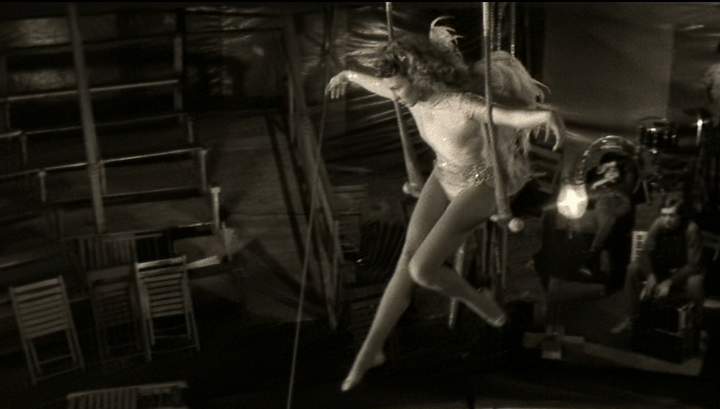
2. Five Angels for the Millenium (2001) - Bill Viola
3. Quote.

The art historian John Walsh has argued that the water in Five Angels for the Millennium plays a significant role in expressing Viola’s spiritual concerns by evoking ‘a luminous void of unknown dimensions where the laws of physics seem suspended and the borders between the infinite cosmos and the finite human body merge’

Transcendence

1. going beyond ordinary limits; surpassing; exceeding.

2. superior or supreme.

3. Theology. (of the Deity) transcending the universe, time, etc. Compare immanent (def 3).

Some films, through their exceptional beauty and truth and goodness, achieved something that felt like spiritual epiphany, something immanent and cathartic and moving. I believe this is attained mainly because of a character that is transcending time, and thereby transcending death.

The ending scenes of The New World - Transcending time through innovative editing, by contrasting the moments where the character feels her imminent death upon her and the moments where she feels most alive. -, Ordet - Quite literally, a character is resurrected from the dead. - and Breaking The Waves - The main character and the love she has/had lives on. This is done by using a visual motif-symbol, namely church bells ringing. - come to mind.

Transcendental style in Film:
http://www.paulschrader.org/articles/pdf/1972-TransFilmSeriesNotes.pdf

Der Himmel über Berlin seems to achieve the opposite of transcendence, by investigating and exploring transcendence.
Handke's and Wenders's Wings of Desire: Transcending Postmodernism
http://www.jstor.org/stable/407304?seq=1#page_scan_tab_contents


Movie still from Der Himmel über Berlin

woensdag 22 juli 2015

Beyond Postmodernism - Beyond the Self

Martin Buber talks about two modes of existence:
  • I-It  
  • I-Thou
I-It is like subject-object relation, I being separate from it.
I-Thou is a relationship in which the other is not separated by discrete bounds. Nondualism.

"After absolute encounter we come to see every other being (nature, animals, people) as a You. We come to feel affection for everyone and everything, and to have a sense of loving responsibility for the whole course of the world. This transformation, Buber tells us, is divine revelation." - SparkNotes: I and Thou: Summary

I and Thou relates to Tat Tvam Asi.
The meaning of this saying is that the Self - in its original, pure, primordial state - is wholly or partially identifiable or identical with the Ultimate Reality that is the ground and origin of all phenomena.

It also relates to "Waḥdat al-Wujūd" (Unity of Existence) in Sufi metaphysics.

Joanna Overing on the Self in Piaroa society:
"The Piaroa view is radically externalist: the forces for selfhood have their origin external to the self, and as such have significance in the wider cosmic order.
Such a view is in contrast with the Western notion of the self, which is radically interiorised from the start, with consciousness and reason conceived in large part as autochtonous to the mind itself."
Since the advent of postmodernism this Western notion of the self is under siege, according to Rick Roderick. But perhaps we simply have to shift perspectives and aim for I-Thou relations with the world.
http://rickroderick.org/category/the-self-under-siege/

https://www.academia.edu/7359786/The_Conscious_I_the_Life_of_Desires_and_the_Attachment_to_Custom_A_Piaroa_Theory_of_Practice

Thoughts on Universe of Things: On Speculative Realism, by Steven Shaviro:
http://www.shaviro.com/Othertexts/Things.pdf


Drawing on process philosophy and evolutionary panentheism by Alfred North Whitehead. Video by 0ThouArtThat0.

David Ray Griffin on Panentheism, a Postmodern revalation:

https://books.google.nl/books?id=N123ZrSR2b0C&pg=PA36&hl=nl&source=gbs_toc_r&cad=4#v=onepage&q&f=false

maandag 27 oktober 2014

Masks and fluid identity


"Myths are always there, even if indirectly and by hidden ways, for the good reason that they are invented by the natives themselves, searching for a parable of their own fate."

"We have inherited an unconscious and ambivalent involvement with the colonial transaction of defining Europe's others as primitives, which, reciprocally, maintain an equally mythical 'western' ethnic identity."
- Susan Hiller from the Myth of Primitivism

Child as early state, a naive simple expression of unfragmented consciousness; psychological primitivism. Child as Jungian archetype.

Primitivism is integral to art?

Anthropology <-> Artist
Factuality <-> Fantasy

Man Ray - Black and white
Cultural appropriation


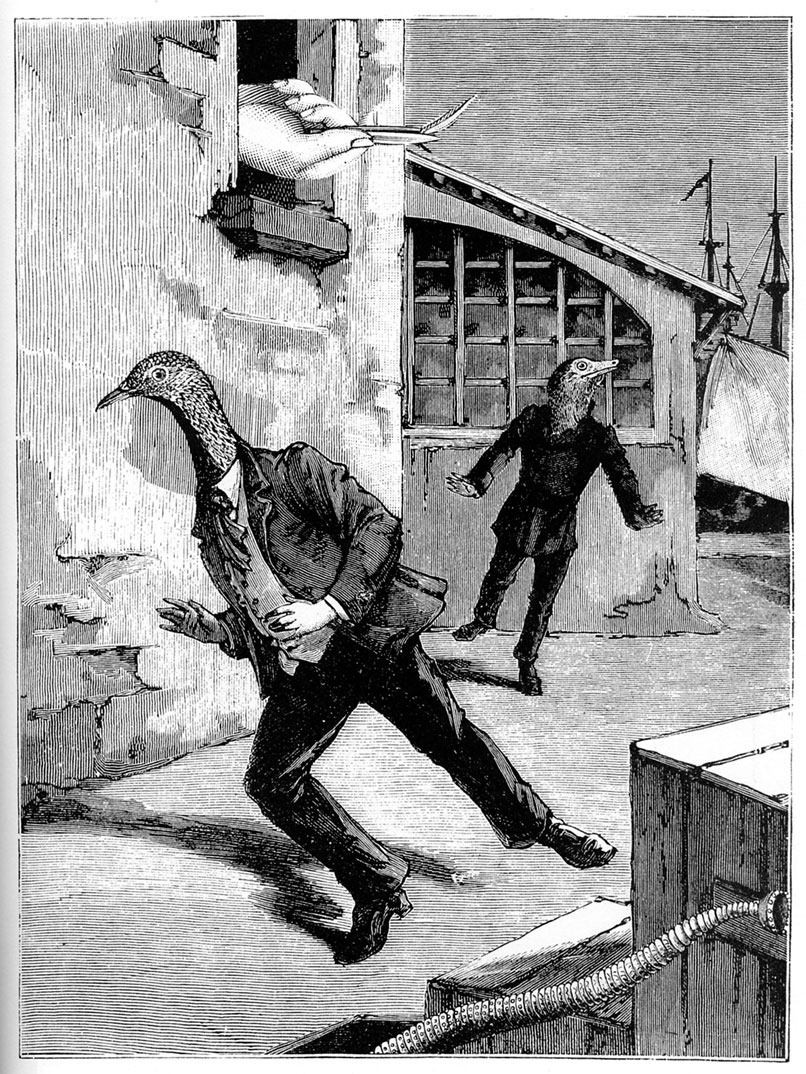
Loplop - Max Ernst. Alter ego; personal totemic myth, familiar spirit
http://en.wikipedia.org/wiki/Loplop


Random interesting video editing of faces.


maandag 29 september 2014

End of History vs Neverending Story

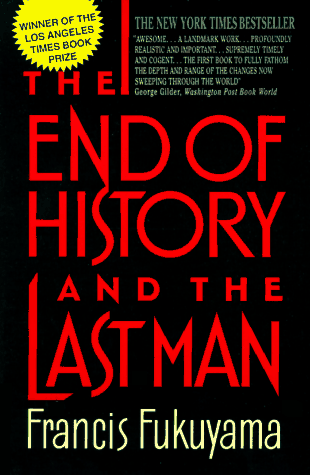
Last thursday I went to Stedelijk Museum Amsterdam for the Metamodernism symposium, a marathon of lectures. I missed the lecture on the future of history by Francis Fukuyama since it was already sold out. The second lecture by Camille de Toledo (2001) was the most relevant for my research as well as the most inspiring and imaginative. The others (2008, 2011) focused a bit much on politics, economics and the financial crisis instead of arts and culture. But this was to be expected. The lecture by novelist Adam Thirlwell was about new sincerity and collaboration in literature amongst other themes.

My interpretation of the notes I made during the lecture by de Toledo:

Our times are defined by horizontalism vs verticalism. The Berlin wall was a perfect symbol of verticalism and violence. (For most Russians this was a dramatic event though, the coming into contact and experience with democracy). If I remember correctly, he tells a story of a cellist playing music during the fall of the Berlin Wall. But as he plays, people start throwing coins at the cello master. Suddenly the master turns into a beggar… There is a certain sense of the dialectic between horizontality and verticality to the story.  In a later lecture the story of the grasshopper and the ant was recalled, one of Aesop's fables. The grasshopper was singing during the warm summer months while the ant was working hard. When winter came, the grasshopper was dying on the streets, knocked on the door of the ant, but the ant refused help and told the grasshopper to dance during the winter. Now, is the ant a flawed character, yes or no?
Horizontality can be understood as a Habermasian understanding of democracy.
Dialectic can be linked to concept of vertical individualism/vertical collectivism/horizontal individualism/horizontal collectivism.

Airport as a symbol of globalism. See also "non-places" as defined by Marc Augé, to refer to places of transience that do not hold enough significance to be regarded as "places".

There was an endless repetition of 9/11 on our television screens. The images were and are repeated endlessly and ingrained into our brains and collective understanding. We could say that this repetition of (mass) media itself is in a loop. There is no beginning or end to the narrative. It's mostly repetition. Media is one of the causes of an end of history.
There are no ends to myths itself either; they are circular in time. Eliade suggests that the abandonment of mythical thought and the full acceptance of linear, historical time, with its "terror", is one of the reasons for modern man's anxieties.

End of history should be understood not as Hegelian, but rather Kantian: reaching eternal peace, as according to Toledo. Perhaps this could be mixed by Eliade's understanding of myth and the concept of eternal return.

He came up an example. When he reads stories to his children, the children do not want the story to end. But what do they actually want, a continuation of the story or the story to be repeated? Toledo says there is always expectation. At the end comes a new beginning.


One of the slides from the lecture by de Toledo.

2001 was the beginning of the end of Fukuyama. Has history begun again after 2001?
La chute de Fukuyama/The Fall of Fukuyama examines catastrophe and the relationship between humans and History.

The opera takes place simultaneously before, after, and during the attacks of September 11, 2001: that is, between the dream of eternal peace and the return to war, between the memory of the 20th century and the general fiction of the 21st. In several languages, the travelers follow History as it unfolds in the distance on the plasma screens they wander in front of. Between fear, stammering, and madness, they reflect upon the first years of the 21st century, years of war during which the real took on the form of total fiction. The travelers in The Fall of Fukuyama want to act on History, tie themselves to it – but they remain helpless.

http://chutedefukuyama.com/en/ 


The Neverending story is about reinterpreting tradition, which sounds a lot like something Eliade would say. There is a certain character in the story who is always looking forward to the future, a reopening of a new future. Again a focus on expectation. Expectation and hope is secularised nowadays, while the neverending story has a focus on magic and fantasy.
He argues we have to take a look at the totem instead of the narrative, simply to get rid of the end narrative. The totem maintains the order of law. It is stable. The symbol of the totem can be exchanged by the myth I think.

One of the other slides was a sort of comic strip of Fukuyama falling. de Toledo imagines Fukuyama as a voodoo doll in a shamanistic practice.

A secularized expectation can be found in the 2008 Obama campaign. Focus on themes such as Hope and unity.

He ends with the question how to bring back history in Europe.

One of the panel members ends his story by saying:
"We're all mayflies in the course of history."

During the symposium Shia Labeouf was running a "metamarathon" around the Stedelijk.

donderdag 18 september 2014

We Need a Myth?

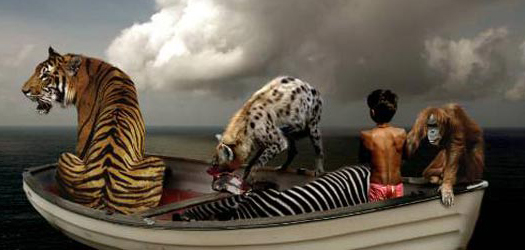
The book and movie Life of Pi, which perfectly illustrates two different versions of looking at a certain event (from a rational one versus a religious, magical one), got me thinking about myth-making. The story is basically an argument for the existence of God.


I think it also perfectly represents our times and is best explained with a concept by Max Weber which he called: "the disenchantment of the world", a process of rationalization in a secularized modern bureaucratized Western world, a world which has lost deeper values and meanings ... Life of Pi wants to enchant the world once again by returning to the myth as a deeper truth, to better connect with us on a deeper level, by ways of powerful storytelling. It's leans heavily on aesthetics: the mythical version of the story is beautiful and brings hope and optimism, the actual realistic version is ugly, dark and meaningless. Now what version of the story would you choose?

In a way this also explains why so many people are believers, otherwise we might easily lapse into nihilism.

The need for a myth of course relates to Carl Jung's concept of collective unconscious and archetypes: universal thought patterns we inherented from our ancestors and which are part of our biological make up, and in ways to Joseph Campbell's monomyth: cyclic journey of the hero (Harry Potter, Star Wars and Lord of the Rings also follow the monomyth structure). George Lucas even did so on purpose. All of these stories connect with us on a deeper level.

With our pluralistic society comes confusion, confusion of identity, of belonging, a lost sense of meaning...These films all have a mythical sense to them and might actually replace our need for religious myths, or perhaps fill a certain void. I remember Nietzsche saying myths serve a purpose of generating life-affirmating attitudes.


We need a myth
We need an amethyst bridge
We need a high hanging cliff
Jump, fall, and lift
We can make it

But we need a myth
We need a path through the mist
Like in our beds, we were just kids
Like what was said by our parents

A myth
Guess what we're after is just this
A myth
Guess what we're after is just this

We need a myth
I feel my heart's like a fist
Words spilling out of the blessed lips
Of any prophet or goddess

I need a myth
Brought back to life by a kiss
Scrape away grey cement
Show me the world as it was again
As it was in a myth

A red ribbon to reconnect
The lady's head to her neck
And to forget that her throat
Was ever slit

Guess what we're after is just this
It's a myth
Guess what we're after is just this

Oh, and I'm sick of all these picture books that try
To steal some old reflections for their light
But desperate measures point to desperate times
And that's why
We need a myth

We're cut adrift
And we need a mass uplift
The world is trembling and weeping
Just at the point of believing
In a myth

The sun that shines on my head
The moon that lights me to bed
Were two identical twins
Inside of a myth

I heard the voice of a friend
On Lethe's banks, wading in
And he said
"Well, before I forget
We need a myth

And as we lean in to kiss
To get two nails through the wrist
To get covered in blood
And get covered in spit
And to forgive."

If all we're taught is a trick
Why would this feeling persist?
And with the truth closing in
I must insist:
We need a myth. 


Song by Okkervil River:


Artificial Sun


The Weather project, Studio Olafur Eliassion, 2003

Plato's pharmacy by Derrida

In this essay Derrida takes a closer look at the myth of Teuth included at the end of Plato's Phaedrus.

Socrates never wrote anything himself, Plato did. And writing is sophistry, like rhetoric, and speech is socratic, according to Plato. Now, Plato of course wrote in dialogues and it is often up to the reader to take a certain side.

Plato's case is clear and he sides with Socrates and thus king Thamos: writing will only create forgetfulness and is not a remedy for memory itself, but a way of reminding. Writing is a not a "remedy" (pharmakon) for memory but instead it is "poison" (pharmakon). Pharmakon can mean both things.

As a side note, it is interesting that Theuth, the inventor of writing, symbolizes the moon, and king Thamos, the judge, is interchangable with the sun God Amon. Writing is a reflection just like the moon reflects the sun.

Derrida wants to deconstruct the opposition of writing/speech. Now Derrida focuses on the word pharmakon, which is affiliated with writing. He states that writing itself cannot be reduced to the series of oppositional concepts that it precedes and produces . So he is saying that writing is the origin of the origin and that the son (Theuth) fathers the father (Thamus). Pharmakon is the prior medium in which diferentiation is produced.

This means that it is impossible to attach conceptal opposites (differentation) like remedy/poison, good/bad, light/dark etc. without writing. Writing constitutes the medium in which opposites are opposed. Pharmakon produces difference.

I'm reminded by Derrida's famous statement "There is nothing outside the (con)text".
Text, according to Derrida refers to context and includes all about the "real-life" situation of the speech/text.

___


Socrates is actually standing in for Thamos (presence), while Phaedrus is standing in for Theuth (absence).
Thamos is closer to the Forms, while Theuth is all about shadows. Theuth is supplementary to Thamos, according to Plato.
Socrates is setting up logocentrism here in Western philosophy, which is the view that speech and not writing is central to language.

Now I understand that Pharmakon is an example of Derrida's concept of trace. A trace is originary, it conveys the impossibility of an origin or a centre (like logocentrism). So when you say pharmakon signifies Remedy it implies that it is not Poison. It implies what is does not mean. They are interdependent. So speech is in a way dependent on writing as well! Writing is not exterior to speech but also has a quality of interiority itself.

So Derrida suggests that written symbols are signifiers on their own (and not signifiers of signifiers), that they should not be considered as derivative from speech.

And if writing is supplementary to speech, it also implies that there is a loss of presence in speech that must be supplemented by writing. Writing may recover what is lacking in speech. So writing is not merely absence, just as speech is not merely presence. Speech occurs in writing and writing occurs in speech.